Friday, January 22, 2016

REAL ESTATE TOPICS...First-Time Buyers: How Much Down Payment Do You Really Need These Days?

By By Teresa Mears
For someone who is thinking of buying a first home, the idea of saving enough money for a 20 percent down payment can be daunting. The good news is a first-time buyer can purchase a home for a little as 3 percent down -- and even no money down in some cases.
"The narrative that in order to buy a house in America today you need 20 percent down is just not true," says Marietta Rodriguez, vice president of national homeownership programs and lending for NeighborWorks America, a national nonprofit focused on community development and homeownership. "There are a lot of different products that offer low down payment options."
If you otherwise qualify for a mortgage, you can qualify for one with a lower down payment, though some options are only available to those with good credit. But you will pay more. That's partly because if you pay less upfront, your mortgage balance is higher. Another reason is if you don't make a minimum down payment of 20 percent, you will usually be required to pay private mortgage insurance.
PMI, as it is commonly known, protects the lender if you default on your loan. On a conventional loan, it's usually added to your monthly payment. For loans offered by the Department of Veterans Affairs, the U.S. Department of Agriculture and the Federal Housing Administration, mortgage insurance is handled differently.
"The less you put down, the higher the mortgage insurance is," says Casey Fleming, author of "The Loan Guide: How to Get the Best Possible Mortgage" and a mortgage professional in the San Francisco Bay Area. "With 5 percent down, the mortgage insurance is quite high."
The cost of private mortgage insurance depends on your credit score and the size of your down payment. Freddie Mac estimates the cost at $30 to $70 per month for each $100,000 borrowed. The Freddie Mac website calculates that if you buy a $200,000 home with 10 percent down with a 30-year fixed rate of 4.5 percent, you'll pay $80.75 a month in PMI (at a rate of 0.51 percent), in addition to the $962 monthly principal and interest payment (taxes and insurance are added on top of that). With 20 percent down, you'll pay $810.70 per month.
If you need to pay PMI, the size loan you can get will be slightly smaller, to allow for the bigger payment. With a conventional mortgage, you can get an appraisal and write to your lender and ask to have the PMI removed once you have more than 20 percent equity in the home. With FHA loans, PMI lasts for the lifetime of the loan.
"Anyone with decent credit can get a loan," Fleming says. "The limiting factor will always be the PMI."
If you have a choice, should you make a bigger down payment to avoid PMI? It depends on your personal circumstances. You need to make sure you have enough cash on hand for closing costs and repairs. Some lenders will require a certain level of reserves before they will grant the mortgage.
"There's really no hard and fast rule out there," Rodriguez says. "Inasmuch as they have a choice, and have something to put down, they can run through different scenarios."
Even with no down payment, homebuyers still need some cash to cover closing costs and upfront costs, such as a year's worth of taxes and insurance. Some loan programs allow buyers to use a contribution from the seller or a gift from family for closing costs and down payments, but others do not.
"That means you need to be putting money aside," says Sandee Rains, a financial education specialist in Tampa, Florida, with the nonprofit ClearPoint Credit Counseling Solutions.
If you're considering buying a home, it's smart to meet with a mortgage officer or broker before you start looking at property. "Sit down with somebody who can show you what all the costs are really going to be," Fleming says. A good mortgage broker can help you weigh your options and decide how large a down payment to aim for, as well as which loan program is the best option.
Rodriguez suggests consulting a financial counselor who can examine your financial life in its entirety. "It's really to help you plan your financial future," she says. "Homeownership might be only one of those goals."
She and Rains also recommend checking with local authorities for programs that offer assistance with down payments and closing costs. "There's just a lot going on in communities that people aren't aware of," Rodriguez says.
Some programs provide down payment assistance as a silent second mortgage, with no payments due until the home is sold or refinanced. Other programs offer grants or forgive the loan once you live in the home for a certain amount of time. "If someone qualifies for any down payment assistance, they should go for it," Rains says.
Here are four types of loans you can get with a low down payment, which may be especially appealing to first-time buyers. A quality lender or mortgage broker will offer all these options and help you figure out which is the best fit for your situation. Some programs also set standards for the home or condo, including a maximum price and the condition of the home.
Conventional mortgage. Fannie Mae and Freddie Mac will back loans with down payments as low as 3 percent. You will need solid credit to get these loans, but they will be cheaper than an FHA loan. The more you put down, the less your PMI. If your lender says he doesn't offer those loans, you should shop around.
Federal Housing Administration loan. TheFHA has long backed loans with down payments as low as 3.5 percent. It accepts buyers with lower credit scores and those with thinner credit records. Buyers are required to pay mortgage insurance premium of 1.75 percent of the loan amount up front, though it can be financed. There is also a monthly MIP for as long as you have the loan, which averages about $70 forevery $100,000 borrowed. FHA also offers the 203(k) loan, which can be used to both buy and rehab a home at the same time.
U.S. Department of Veterans Affairs. If you served in the military, you can get a VA loan with no down payment. You're required to pay a funding fee of 2.15 percent of the loan amount upfront instead of PMI, which can be financed. If you have a service-connected disability, the funding fee is waived. You still have to qualify for the loan based on income and credit, but the interest rate is likely to be lower than a conventional or FHA rate, plus there is no monthly PMI. "It's a really good program," Fleming says.
U.S. Department of Agriculture. The USDA guarantees loans with nothing down in rural and suburban areas to those who meet income and other qualifications, and the rates are often lower than those of conventional loans. The USDA charges an upfront mortgage insurance premium of 2 percent of the loan amount, which can be financed. After that, the charge is about $33 a month per $100,000 financed. 

REAL ESTATE TRENDS...Home Remodeling Activity Looking to Gain Steam Through Mid-Year

BY Abbe Will
Research Analyst
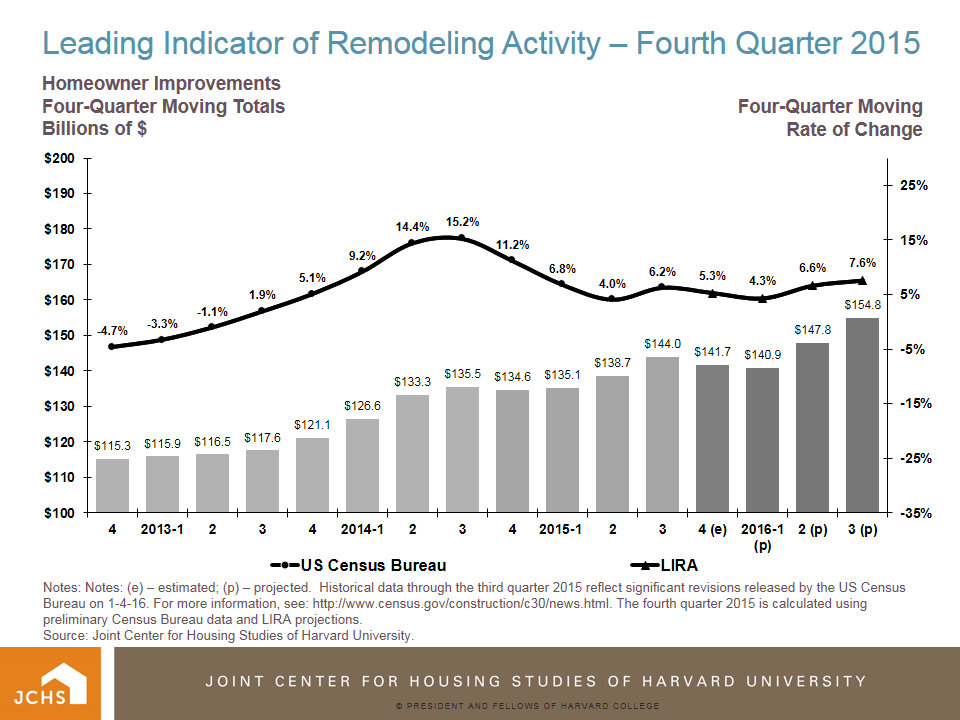
Expenditures for home improvements should see healthy gains in 2016, according to the Leading Indicator of Remodeling Activity (LIRA) released today by the Remodeling Futures Program at the Joint Center for Housing Studies of Harvard University. The LIRA projects annual spending growth for home improvements will accelerate from 4.3% in the first quarter of 2016 to 7.6% in the third quarter. By then, the level of annual spending in nominal terms is anticipated to surpass the previous peak set in 2006.

2016 is looking to be a stronger year for home renovation activity compared to 2015 thanks to the continued recovery in the owner-occupied housing market. In most markets across the country, rising house prices are bringing more homes to the market and increasing sales, which is a large driver of home improvement activity.


The remodeling market has steadily improved in recent years with homeowners incorporating larger, more discretionary projects into their home improvement priorities. The real test this year will be whether the industry can clear ongoing bottlenecks in labor availability and consumer financing concerns to fully meet this increased demand.  (Click chart to enlarge.)

Thursday, January 21, 2016

REAL ESTATE NEWS...U.S. TO START TRACKING "SECRET" LUXURY BUYERS

U.S. TO START TRACKING "SECRET" LUXURY BUYERS
The Treasury Department announced last week that it will begin tracking all "secret buyers" of luxury properties as concerns mount about money laundering in high-end real estate. The initiative requires shell companies that make all-cash real estate purchases to expose the buyers' identities. The Treasury is asking title insurance companies to discover and report the identities of these buyers.

The government said it would allocate more resources into investigating luxury real estate sales that involve shell companies, such as limited liability companies, partnerships, and other entities. The government will begin its new program in New York's Manhattan as well as Miami-Dade County in Florida. In Manhattan, buyers who purchase property at a sale price of more than $3 million must be reported, and in Miami-Dade County, more than $1 million.

A New York Times series last year revealed that real estate professionals in the luxury market often don't know much about their buyers as the use of shell companies rose with foreign investment in U.S. real estate. In fact, the Times found that nearly half of homes nationwide worth at least $5 million were purchased using shell companies.

REAL ESTATE TOPICS...Which Renovations Are and Aren't DIY

Which Renovations Are and Aren't DIY

Your buyers like the house — mostly — but the closets could be reconfigured and the bathroom tile has to go. Are those DIY projects, or are they "DIFM" (do it for me)? In a new survey from the Home Projects Council, home owners reviewed a range of home improvements. Most said they would feel comfortable doing the projects in the first chart below, but for the second, it's best to have professional referrals ready.
Home improvements owners are most comfortable doing on their own:
IndoorOutdoor
Install window treatments, curtains, blinds, or shuttersBuild or install a mailbox
Install new cabinet hardwareStain or paint patio or other concrete surface
Install a closet system or shelvesLandscape yard
Install a lighting fixture or ceiling fanClean, repair, or seal patio or other concrete surface
Install a faucet or shower headInstall paver or stone patio or walkway

Home improvements where you'll likely need to refer a pro:
IndoorOutdoor
Install or replace a countertopPour a concrete patio, steps, or sidewalk
Install cabinetsBuild a deck
Tile a showerBuild an outdoor kitchen, barbecue, or fireplace
Replace wood or vinyl floorsBuild a fence
Install a backsplashInstall or build a shed or storage building

The Home Projects Council is a home improvement think-tank organized by Quikrete, a manufacturer of packaged concrete and cement mixes. Among the members are This Old Housesenior technical editor Mark Powers; Cleveland Plain Dealer home-improvement columnist Jill Sell; Danny Lipford, host of "Today's Homeowner"; and REALTOR® Magazine publisher Stacey Moncrieff. The HPC will be discussing the survey findings Wednesday during a roundtable at the International Builders Show in Las Vegas.Not surprisingly, the online survey of 514 owners found that DIYers (45% of respondents) spent less on their last home improvement project than DIFM homeowners (55% of respondents).  Regardless of how they described their own skill — beginner, intermediate, or expert — cost was the biggest driver for DIYers; 53 percent said the main reason they did the project on their own was because it was less expensive than hiring a pro. But nearly 30 percent said their main motivation was that they enjoyed the work.

REAL ESTATE TOPICS...Housing Affordability Constrains as Expansion Matures

Katie Penote

202-752-2261

WASHINGTON, DC – Fannie Mae’s (FNMA/OTC) Economic & Strategic Research (ESR) Group’s theme for the economy and housing market in 2016 centers on the challenge of housing affordability coupled with expected modest economic growth, as the expansion progresses through its seventh year. In their January 2016 Economic & Housing Outlook, the ESR Group expects that further labor market tightening will lead to increased household income and job security amid more relaxed lending standards and easier access to mortgage credit. However, strong home price gains, especially in the lower-end of the market, continue to outpace household income growth, eroding affordability. Consumer spending is expected to underpin economic growth again this year, while residential investment and government spending should help drive growth despite some drag from net exports. Overall, the ESR Group expects the economy to grow 2.2 percent for all of 2016, with China’s deteriorating economic activity, a stronger dollar, geopolitical turmoil, and uncertainty about monetary policy remaining downside risks to the outlook.
“We ended 2015 with a positive jobs report, an annual record high for auto sales, and the housing market poised to be the strongest since 2007,” said Fannie Mae Chief Economist Doug Duncan. “The first fed funds rate hike since 2006 has had a minimal impact on mortgage interest rates so far, and we believe mortgage rates will edge up only gradually, ending the year around 4.2 percent. Despite our expectation of only a small rise in mortgage rates, home price and income dynamics should inhibit home purchase affordability. In addition, continued rent increases will hinder renters’ ability to save for down payments. Therefore we believe the pace of improvement in total home sales should moderate to 4.0 percent in 2016. However, we expect the increase in single-family starts to accelerate to 17 percent this year, if easing housing supply shortages and a continued strong pace of household formation pan out.”

Wednesday, January 20, 2016

REAL ESTATE TRENDS...8 ways to boost your home value

8 ways to boost your home value

When Alec and Jennifer Harmes spent $264,900 for their first home in 2011—a 1,500-square-foot ranch fixer-­upper in Austin, Texas—they assumed they would be living there for many years. So the couple, millennials in their early 30s, embarked on a series of home improvements to make it suit their tastes and needs. They refinished the kitchen cabinets, and installed new stainless-steel appliances and LED lighting. New engineered wood floors replaced the mishmash of linoleum tiles and musty, high-maintenance carpeting.
Outside, they removed the asbestos siding and installed durable, no-paint fiber cement. They also used that moment to rewrap the house in rigid insulation, improving its overall energy efficiency. Though the Harmeses saved big by doing most of the work themselves (he works in construction management, she oversaw design), the total investment was close to $65,000. They were even planning to build a separate mother-in-law apartment on the property to help lure family to Austin. But their folks didn’t want to relocate, so they made the tough decision to move back to Florida to be close to them. “If we could have picked up that house and brought it with us, we would have,” Jennifer says.
Lorella Martin of Redfin, an online real estate brokerage, was the Harmeses’ listing agent; she set the asking price at $450,000. The first open house was like a feeding frenzy, attracting many young professionals eager to move into the popular Austin neighborhood, she says. And it wasn’t hard to figure out why. “When a home is move-in ready and buyers know they can be cooking in the kitchen from day one and entertaining in the backyard that very weekend, you know you’ve got a winner,” she says.
The house sold for $472,000.
Granted, some of the roughly $200,000 increase in home value had to do with the Austin market’s 20 percent appreciation in the Harmeses’ 3½ years of stewardship. But it’s also a testament to the couple’s savvy instincts about what today’s buyers are looking for, especially now that millennials, 75 million strong, have become the leading cohort of buyers, purchasing 32 percent of homes in 2014.
So let the following renovation rules, driven by shifts in the current housing market and informed by Consumer Reports’ nationally representative survey of 1,573 millennials, inform your decisions on improving your home and its value.
1: The Kitchen Is Still King
Buyers of all kinds have long focused on the kitchen, but it holds particular sway over the newest wave of first-time homeowners. A “modern/updated kitchen” topped the list of ideal home features in our survey of millennials, registering as most important to more than a third of respondents. If you plan to sell, don’t rip your kitchen down to the studs; a smaller investment can have serious impact. For as little as $5,000, you should be able to add a new suite of appliances, as well as a new countertop and flooring, resulting in a fresh, coordinated look. Applying a fresh coat of paint to the walls or cabinets, and updating the hardware, can also breath new life into the space. (Check our kitchen planning guide for more information.)
Value-Added Buzzwords
Stainless steel. 
Though it has been around for decades, this appliance finish conveys clean, contemporary design, so it will signal “updated” in the mind of the buyer. For the latest spin on stainless, look for new versions of black stainless steel from KitchenAid, LG, and Samsung, each with a softer, less reflective finish but the same cachet as the original.
Quartz countertops. Engineered from stone chips, resins, and pigments, quartz has started to challenge granite and marble as the go-to material in higher-end kitchens. It shrugged off heat, scratches, cuts, and stains in our tests, and it requires none of the upkeep of comparably priced natural stones. Expect to spend $40 to $100 per square foot, installed.
Potential bump in sale price: 3 to 7 percent
2: Make Floor Plans Work Harder
Bigger isn’t necessarily better in today’s market, but strategically increasing the amount of living space is sure to boost home value. An “open floor plan with flexible living space” was second only to an updated kitchen on millennials’ list of most desired features.
Finishing a basement is the most common way to add usable square footage to a home. Most homeowners spend between about $10,000 and roughly $27,000 converting a basement, depending on the size of the space, according to estimates from HomeAdvisor, a website that connects homeowners with prescreened service professionals. Attic conversions are another option. The average attic remodel in 2014 cost $50,000.
Many younger buyers will envision the additional living spaces as a dedicated office, especially if they work from home. And at the other end of the spectrum, “a lot of my boomer clients are daytime caretakers for their grandkids,” says David Pekel, who owns a remodeling company in Wauwatosa, Wis. “They want a playroom that they can close the door to after the kids leave, so they’re not dealing with toys underfoot.”
Value-Added Buzzwords
Flex rooms.
 Also known as double-duty rooms, you’ll see flex rooms advertised as an additional living area that can serve a variety of purposes, from a guest bedroom to a game room to an exercise room to a study room for the kids.
Mother-in-law apartment. These spaces go by many names, including “granny flats,” “casitas,” and the technical sounding “accessory dwelling unit,” or ADU. They can house an additional family member or provide rental income—­allowing baby boomers to afford their house once they retire or helping millennials pay the mortgage. More municipalities, particularly in Western cities, are amending zoning laws to allow for ADUs.
Upstairs laundry rooms. Younger buyers in particular say they want a dedicated laundry room, perhaps off the kitchen or even near second-floor bedrooms. Manufacturers are obliging withwasher/dryer sets with a matching fit and finish that neatly integrate into the living space. We like theMaytag Bravos ­MVWB855DW HE top-loader and Maytag Bravos ­MEDB855DW electric dryer, $1,050 each.
Potential bump: 4 to 6 percent
8 ways to boost your home value

3: Don’t Let Your Home Be an Energy Hog
Lowering your home’s energy costs will save you money for as long as you live there and is expected to be a major selling point down the line. Indeed, “energy-­efficient” was second only to “safe community” on the list of attributes that would most influence a purchase decision, according to a 2015 survey by the National Association of Home Builders.
Older homeowners who have felt the sting of escalating energy costs tend to be driving the interest. But there are some early adopters among younger buyers, too, especially in regions of the country with more extreme weather. “My millennial buyers usually ask for two years’ worth of utility payments,” says Joe Rivellino, a real estate professional in the Buffalo, N.Y., area. “They want to know the R-Value on the insulation and whether the windows have low-E coatings,” he says, referring to two important efficiency measures.
And don’t forget about water heating, which accounts for 16 percent of energy costs in the typical home. Spending $1,800 to $2,400 on a new unit is another way to impress efficiency-minded buyers.
Value-Added Buzzwords
High-efficiency windows.
 Energy Star certified windows can lower your home’s energy bills by 7 to 15 percent.
That will be a selling point with buyers, though replacing every window in a home costs anywhere from $8,000 to $24,000, so you probably won’t recoup the entire investment if you plan to sell right away.
LED lights. Some listings emphasize their “green” credentials by mentioning the presence of LED lighting. Choose the Feit Electric 60 Watt Replacement 9.5W LED, a $7 bulb that delivers superb light quality and has a 23-year life expectancy.
Potential bump: 1 to 3 percent
4: Keep It Simple and Stress-Free
Stain-prone stone countertops, grime-­collecting ornate cabinets, and dust-­catching wall-to-wall carpet used to be symbols of luxury, but today’s homebuyers are more likely to equate them with extra work. “We call it stress-free living,” says Miguel Berger, a real estate professional in Albany, N.Y. “The younger generation in particular would much rather spend their time entertaining at home than fussing over it.” It’s safe to assume boomers feel the same.
Beyond a home’s cosmetic finishes, it’s important to keep the major mechanical systems in working order. Many first-time buyers will have used up much of their savings on the down payment, so they want to know that the heating system, plumbing, and electricity have been recently updated. Central air conditioning is also in demand because it eliminates the need to switch window units in and out. ­HomeAdvisor puts the average cost nationwide at just more than $5,000.
Value-Added Buzzwords
Updated systems.
 In addition to including the age of the system, it helps if you can also point to its reliability. For example, Consumer Reports surveys have found American Standard and Trane to be among the least repair-prone manufacturers of gas furnaces.
New roof. This will help assuage fears of water damage, ice dams, squirrel infestation, and other home disasters that can result from an old, shoddy roof. For a typical 2,300-square-foot house, you might be able to put on a new asphalt shingle roof for as little as $6,000.
Hardwood floors. More carpets are being replaced with long-wearing hardwood flooring with a durable factory finish. Engineered wood flooring, which uses a thin veneer of real wood or bamboo over structural plywood, tends not to wear as well as the solid stuff, though it has the same look and tends to cost less, making it a good choice if you plan to sell soon.
Potential bump: 3 to 5 percent
5: Build a Home for ‘the Ages’
By 2040, there are expected to be almost 80 million seniors accounting for 21 percent of the population. The existing housing stock isn’t equipped to safely accommodate that many older people—too many steep staircases, narrow walker-­unfriendly doorways, and slippery step-in bathtubs and showers. Forward-thinking homeowners are making necessary improvements to their home now—and those changes will benefit people of all ages, not just seniors. According to a 2015 survey by ­HomeAdvisor, 56 percent of homeowners who hired a pro for aging-related projects were younger than 65, and 10 percent were younger than 50.
Value-Added Buzzwords
Walk-in shower. 
“People in the 50-plus age range don’t want to step over the tub to take a shower,” Pekel says. Curbless showers eliminate the threshold between the shower and surrounding bathroom, making them wheelchair accessible, not to mention sleek and streamlined.
Master on main. A floor plan in which the master bedroom is on the first floor reduces the need to climb stairs. “It’s probably the most desired feature among boomers,” says JP Endres, a real estate professional based in Westchester county, north of New York City. Creating a truly functional master-on-main suite usually involves a multiroom renovation, which can cost upward of $35,000.
Comfort-height toilets. These toilets are a few inches taller, which makes getting on and off easier. Most top flushers in our tests are comfort height, including the Glacier Bay N2428E two-piece toilet, which sells at Home Depot for $100.
Potential bump: 1 to 2 percent
6: Paint Is Still a Potent Upgrade
Paint keeps your home looking its best while also defending its surfaces from wear, tear, and the elements. If you’re getting ready to sell, don’t blow thousands having every square inch repainted. Instead, focus on high-traffic areas, including the kitchen and bathrooms. “Your home has to look better on the day of the open house than it’s ever looked before,” says Steve Clark, a real estate professional in Los Angeles. “If the back door is covered in scratch marks from the dog, you have to fix that.” Do the job yourself for about $100 in material costs or pay a professional $1,000 or so, which should cover multiple rooms.
Value-Added Buzzwords
Neutral color scheme.
 Whites and off-whites remain the top-selling interior colors and will appeal to most homebuyers, allowing them to envision the space as their own. Neutrals appeal to all generations of buyers, according to Jule Eller, trend and style director at Lowe’s.
High-quality paints. Home Depot’s Behr Marquee, $43 per gallon, is our top-rated interior paint. For outdoor projects, Behr Premium Plus Ultra Exterior, $39 per gallon, and Clark+Kensington Exterior from Ace Hardware, $35 per gallon, offered the best protection.
Potential bump: 1 to 2 percent
7: Remember the Great Outdoors
Your home’s property is another opportunity to expand its living space. Adding a deck or patio, with room for seating and a built-in or freestanding grill, is a way to create a defined space for outdoor living on a large or small scale.
But remember the rule of low upkeep, especially if your future buyer is likely to be a millennial. “They love outdoor spaces, but whereas prior generations might have gone for the pool, Gen Yers recognize the maintenance costs associated with it,” Berger says. “They’d much rather see an outdoor fire pit surrounded by a simple seating arrangement.” Don’t go for overly lush landscapes, especially in drought-stricken regions with high water costs. (Check our guide to outdoor living.)
Value-Added Buzzwords
Curb appeal.
 Trimming overgrown shrubs and making minor repairs to the façade, including painting the front door, can deliver quick results. Replacing worn-out siding is a major undertaking, costing $12,000 on average, but it can give your home a complete facelift.
Water-smart yard. Replacing a section of turfgrass with native ground covers or pea gravel will reduce the maintenance costs while adding visual interest.
Potential bump: 3 to 5 percent
8: Make Sure Your New Technology Is Smart
High-tech features offer notoriously bad returns on investment because technologies tend to evolve quickly. “One of the biggest losers in recent years is the fully wired audiovisual system,” says Duo Dickinson, an architect based in the New Haven, Conn., area. “They’ve probably lost 80 percent of their value since everything went wireless.”
But certain smart devices add to home value and interest, including programmable thermostats. “I’ll often install a Nest thermostat in a home that doesn’t have one because it creates the impression that this is a high-tech home,” Berger says.
We’re seeing the same benefit with a range of products, such as lights, door locks, and security systems. Those smart features have broad appeal with millennials, “who grew up on smartphones, so they’re used to being able to control things at their fingertips,” Endres says. “And they’ll pay 3 to 5 percent more for a home with the right amenities.”
Value-Added Buzzwords
Programmable thermostat. The Nest is widely recognized, but the Honeywell RTH9590WF, $300, proved easier to use in our tests. Both models can be controlled from a smartphone or computer.
Whole-house generator. Power failures are a reality for more homeowners. Stationary generators can usually power the entire property. A professionally installed unit can range from $7,000 to $15,000, according to Porch, a website connecting consumers with home service pros. The Generac 6241, $3,500, excluding installation, is a top pick.
Potential bump: 3 to 5 percent
Tuesday, January 19, 2016

REAL ESTATE TOPICS...Where Is A “Bargain” Really A Bargain?

Homes advertised as a bargain aren’t necessarily a good deal. Only 55 of the 100 biggest U.S. housing markets where properties described as a “bargain” are actually listed for a lower price

By Ralph McLaughlin | 

The B-word – bargain – gets thrown around a lot in the real estate world. Buyers are looking for one, and sellers often use the term to market their home. But talk is cheap, so we’ve combed through all the homes for sale on Trulia in the 100 largest housing markets to find out where properties listed with the word bargain, or similar words, are actually priced at a discount. To no surprise, we found that not all properties listed as bargains are actually a good deal.
In fact,
  • Homes listed for sale with the term “bargain” (or similar) in their description are offered for a lower price compared to other listings without such terms, in only 55 of the largest 100 U.S. housing markets;
  • Markets with the largest discount on bargain properties are in the Bargain Belt, where markdowns range from 10-20%;
  • Markets with the smallest discount on bargain properties are mostly along the Costly Coasts, where price cuts range from just 2-4%.
Bargain Discount Highest in Bargain Belt, Lowest on Costly Coasts

Homebuyers in Midwestern and Southern markets – a region we collectively call the Bargain Belt – are more likely to find that properties described as a bargain actually come with a discount. Of the top 10 housing markets with the largest discount, five are in the Bargain Belt. Dayton and Toledo, Ohio, lead the pack, where, on average, bargain properties come with a 19.6% and 18.1% markdown, respectively. On the median priced home, this translates to a $22,900 price cut in Dayton and $19,848 cut in Toledo. Knoxville, Tenn., Buffalo, and Omaha, Neb., round out the top five, where price reductions range from 11.5%-12.8%.
BargainHomes_V3_Blog graphic 2
Top 10 Housing Markets with Largest Discount on Bargain Properties
#U.S. MetroDiscount %Median Listing Price, Jan. 2013 – Dec. 2015Example Discount on Median Listing Price
1Dayton, OH19.6%$116,900$22,900
2Toledo, OH18.1%$109,900$19,848
3Knoxville, TN12.8%$169,900$21,831
4Buffalo, NY12.4%$138,888$17,186
5Omaha, NE11.5%$159,000$18,267
6Baltimore, MD11.3%$265,000$29,857
7New Haven, CT11.0%$249,900$27,543
8Camden, NJ10.5%$199,900$20,982
9Madison, WI10.5%$239,300$25,062
10Fairfield County, CT10.4%$535,000$55,593

On the other hand, seven of the 10 housing markets with the smallest discount are along the Costly Coasts. Riverside, Calif., comes to the bottom of the list, where bargain properties will get you just a 2.1%, or $6,480 discount off the median priced home. Homebuyers looking for bargain digs in the Pacific Northwest will only get a 2.8%, or $11,685 markdown, in Seattle and a 3%, or $9,238 cut in Portland, Ore.. Rounding out the bottom five are Orange County, Calif., and Montgomery-Bucks-Chester County, Pa., with a discount of 3.3%.
BargainHomes_V3_Blog graphic 2 copy
Top 10 Housing Markets with Smallest Discount on Bargain Properties
#U.S. MetroDiscount %Median Listing Price, Jan. 2013 – Dec. 2015Example Discount on Median Listing Price
1Riverside-San Bernardino, CA2.1%$310,000$6,480
2Seattle, WA2.8%$419,950$11,685
3Portland, OR3.0%$312,000$9,238
4Orange County, CA3.3%$725,000$23,954
5Montgomery County-Bucks County-Chester County, PA3.3%$324,900$10,815
6Houston, TX3.5%$249,900$8,661
7Worcester, MA3.5%$239,900$8,388
8Dallas, TX3.9%$265,000$10,295
9Denver, CO3.9%$350,000$13,680
10Washington, DC4.0%$429,990$17,274

REAL ESTATE TOPICS...Builders Share Strong Outlook for Green Homes

During the prolonged housing downturn, green homes provided support to the ailing residential market and now promise to be an important element of the recovering market as well, according to a new study conducted by Dodge Data & Analytics, in partnership with the National Association of Home Builders (NAHB) and with the support of Ply Gem Industries.
shutterstock_259778672
Despite the headwinds created by growing concerns about the cost of building green, a high percentage of home builders and remodelers are already building green and expect to do so in the future. While home builders and remodelers report that consumers of all ages are interested in green, the study also finds that consumers aged 55 and older are the most important group driving the current green market.
The findings also demonstrate that consumers’ association of green with healthier homes leads to even higher potential for growth in the future, as do increased use of renewable technologies by 2018.
The new study, “Green and Healthier Homes: Engaging Consumers of All Ages in Sustainable Living SmartMarket Report,” is available here.
The 2015 study, which surveyed 232 builders and remodelers from across the U.S., demonstrates that they recognize the benefits of building green homes:
  • Over half (54 percent) of home builders are currently constructing at least 16 percent of their new homes green, and 39 percent of remodelers report that at least 16 percent of their remodeling projects are green.
  • By 2020, nearly all (81 percent) home builders will be constructing that level of green, with over half (51 percent) building at least 60 percent of their new homes green.
  • By 2020, remodelers report a similar level of growth, with nearly three quarters (74 percent) making at least 16 percent of their projects green, and over one third (36 percent) completing over 60 percent of their projects green.
These expectations of higher green involvement emerge despite growing concerns about the cost of building green. 77 percent of home builders and remodelers report that building green has an incremental cost over traditional construction of 5 percent or more, notably higher than the 60 percent in 2014 and 58 percent in 2011 who noted that level of increased cost. While higher cost is also the top obstacle to green reported, it does not appear to have dampened the drive toward green in the market.
“Builders and remodelers have long recognized that green is the future of home building,” says NAHB Chairman Tom Woods, a home builder from Blue Springs, MO. “Since we first began partnering on this study with Dodge Data & Analytics in 2006, we’ve seen that commitment grow. The study’s recent findings reinforce this continued growth, with new homeowner feedback showing a desire and expectation that new homes be high-performing, particularly when it comes to energy conservation. Most builders recognize that they need to be at least conversant in green to stay competitive.”
One key factor driving the growth of green is the association of green homes with healthier living. Home builders and remodelers certainly recognize the potential: most (83 percent) believe that consumers will pay more for homes that are healthier.
“We have seen the commercial sector of the construction industry focus on the impact of buildings on the health of their occupants in the last few years, but these findings suggest that attention to healthier homes may offer an even higher gain for green in the residential market,” says Steve Jones, Senior Director of Industry Insights at Dodge Data & Analytics, “especially as consumers become better informed about the features that make homes more sustainable and healthier, and begin to demand them.”
shutterstock_192091643Another factor leading to growth in the residential market is the increasing use of renewable energy. The study demonstrates that the use of renewable technologies is expected to grow across the board, revealing an interest in energy performance that goes beyond green. By 2018, nearly half of home builders and remodelers expect to be using solar photovoltaic (48 percent) and ground source heat pump (52 percent) technologies. Net zero homes are also emerging as an important trend, with nearly one quarter (21 percent) of home builders having built a net zero home in the last two years.
One interesting finding of the new study is that the greatest impetus for green homes comes, not from millennials as many people might expect, but from consumers age 55 and older. Data from the study suggest that greater familiarity with home features leads to an emphasis on home performance. Therefore, as the environmentally-minded millennials gain more experience with homeownership, it is quite possible that there could be even greater demand for green in the future.

Friday, January 15, 2016

REAL ESTATE TIPS...How to Vet Real Estate Agents

Picking a real estate agent could spell financial disaster if you choose the wrong one. After all, the goal is to make money on your home -- not lose it.
But how do you know if you've picked the right agent? With more than 86,000 real estate brokerage firms in the U.S. as of 2012, according to the U.S. Census Bureau, you have quite a few resumes and websites to wade through.
Follow these recommendations for vetting potential real estate agents, and you'll find the selling process far smoother.
Treat it like a job interview. Signing with a real estate agent is effectively hiring someone to perform a service, so treat it like any job interview -- where you're the employer. Ask questions, interview more than one candidate and make a decision when you find the right person for the job.
Joe Manausa of Joe Manausa Real Estate in Tallahassee, Florida, says as many as 2 out of 3 buyers and sellers select the first agent they meet, which can easily end in disaster.
"They put so little value in the quality of the people they're going to work with that they end up getting screwed," Manausa says.
Pay attention to how they communicate. Your real estate agent's ability to understand your needs as a client is imperative to selling your home, and possibly finding you a new one.
Richard Ruvin, a real estate agent and team leader for Coldwell Banker in Milwaukee, recommends paying attention to how the agent listens, responds and follows up to your questions, requests and needs. "Almost always the complaints revolve, or the frustrations revolve, around those three," Ruvin says. Not only should agents do all three in a timely manner, but in a way that you prefer, too, whether it's by phone, email or face-to-face meetings.
Ask around town. As with any job interview, you should check for references. Ask the agents you're interviewing for the contact information of previous clients, and take it one step further -- call around to other professionals in the local market to get a feel for their reputation.
Ruvin explains the ability of an agent to work with others in the business is key to the success in selling your home -- if you hire someone who doesn't play nice with his or her peers, you might find few agents willing to show your house to their buyer clients.
"We invest so much effort in developing relationships with other agents in Southeast Wisconsin," Ruvin says. "And that way, if we get to a point where it looks like a deal isn't going to come together, we can rely on the good will we've created with the other side, so to speak, to keep chipping away and working towards a win-win situation.
The agent's reputation will reflect on you as well, says Shannon Sharpe, broker and owner of Sharpe Realty in New Orleans. If you sign with a broker who makes closing a deal difficult, you could find yourself struggling to do more real estate deals in the future. "You want it to be a reflection of how you conduct business," she says.
Talk about marketing and what you can do. In the initial meeting with a potential agent, you should expect her to present everything she plans to do to help you sell your home, including her marketing strategy and what you can do to prepare your home for tours.
Expect a large portion of marketing to be online, as print advertising has largely fallen out of style in a world of to-the-minute listing updates and Instagram ads. "This has become very much an online business. Most of the print advertising out there is designed to pick up listings, and the online listing is designed to pick up buyers," he says.
Listen to money talk with a skeptical ear. Real estate agents will typically give you an estimate on your home's value when they make their pitch, but don't let dollar signs in your eyes cloud your judgment.
Picking a real estate agent based on promises of a higher sale price can leave you with a bad fit, and if an agent is making a higher estimate to try to lure you in, he's probably not a great agent to begin with. Sharpe says a promised price doesn't mean buyers will actually be willing to pay it. "If it doesn't go under contract and it doesn't sell, then it's Monopoly money," she says.
Sharpe adds that selecting an agent who agrees to the lowest commission rate isn't necessarily a smart decision, either. Buyer agents, who will split the commission with the listing agent, can see the commission amount, and may not be inclined to show your property if they know they wouldn't get much reward for their work.
Go with who you trust. Your real estate agent will be privy to a good deal of personal and financial information about you, so only sign with the one you are confident will work with your best interests in mind. Manausa explains he works best when he has open communication with clients about their financial situation and reason for moving. As a result, he can secure the deal that meets their needs, "Tell your agent everything, but only after you hire one," he adds.
When you find the agent you feel comfortable with, you can maintain the relationship for the next time you decide to move, and refer him or her to friends who are buying or selling as well.
Ruvin says his team pays particular attention to establishing long-term connections with clients. "They invariably feel like we're trying to develop a relationship," he says, "and that the questions we're asking and the efforts that we're going through, one wouldn't go through if they were simply looking at a single sale."